
IPTV Setup Guide: Install on Any Device in Minutes
New to internet television? This complete IPTV setup guide walks you through installation on a Firestick, Smart TV, Android box, phone or MAG receiver — plus quick fixes for buffering.
This IPTV setup guide is designed to get you watching in minutes, whatever device you own. Internet television has a reputation for being technical, but the reality is far simpler: install a player, enter your subscription details, and start streaming. Whether you use an Amazon Firestick, a Smart TV, an Android box or a dedicated MAG receiver, the core steps are almost identical. Follow this IPTV setup guide from top to bottom and you will have a fully working service before your tea has brewed.
We have written this IPTV setup guide for complete beginners, so no jargon goes unexplained. You will find a clear walkthrough for each major device, a troubleshooting section for the handful of issues that occasionally appear, and practical tips for the sharpest possible picture. If you can install an app on a phone, you already have every skill this IPTV setup guide requires.
Before you begin, have your provider login to hand: a username, a password and a server URL, or a single m3u link. Those details are the key that this IPTV setup guide turns into thousands of live channels and on-demand films. Keep them private and safe, and let us begin with the most popular device in Britain.
Before You Start: What This IPTV Setup Guide Needs
A minute of preparation makes everything smoother. This IPTV setup guide assumes you have the following ready before installation.
- Your subscription login — username, password and server URL, or an m3u link.
- A stable connection — wired ethernet is ideal, strong Wi-Fi is fine.
- Your device — Firestick, Smart TV, Android box, phone or MAG receiver.
- A compatible player — the app that turns your login into live channels.
- A few spare minutes — most setups finish in under five.
With those in place, the rest of this IPTV setup guide is simply a matter of following the steps for your chosen device.
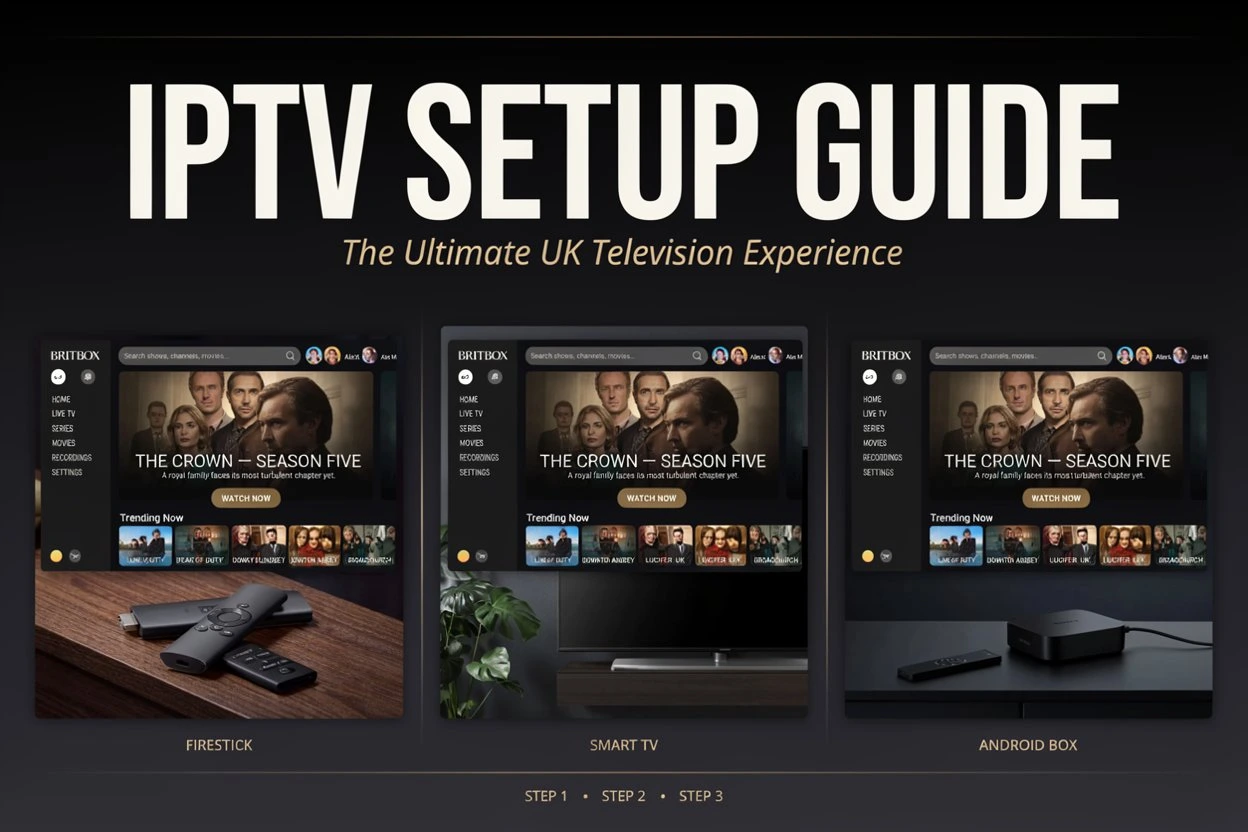
IPTV Setup Guide for Amazon Firestick
The Firestick is the most popular device in Britain, so this IPTV setup guide starts there. Our dedicated IPTV Firestick guide covers it in even greater depth if you need it.
Step 1 — Allow Unknown Sources
Open Settings, then My Fire TV, then Developer Options, and enable "Apps from Unknown Sources". This lets the player install.
Step 2 — Install a Player
Use the Downloader app or the Appstore to install a compatible m3u or Xtream player.
Step 3 — Enter Your Login
Open the player, enter your subscription details, and let the channel list load. Your Firestick is now ready.
IPTV Setup Guide for Smart TVs
Samsung, LG and other Smart TVs need no extra box. This part of the IPTV setup guide gets a built-in television streaming quickly.
Step 1 — Install a Player
Search your TV's app store for a compatible player and install it.
Step 2 — Add Your Playlist
Open the app and enter your m3u link or Xtream login exactly as supplied.
Step 3 — Load and Watch
Let the guide populate and start browsing. Following this IPTV setup guide, a Smart TV is ready in minutes.
IPTV Setup Guide for Android and MAG
Android boxes and MAG receivers are firm favourites too, and this Setup process covers both.
Android TV boxes
Install a player from the Play Store or by sideloading, enter your login, and load the channel list — exactly as on a Firestick.
MAG receivers
Enter your provider's portal URL in the MAG settings, reboot the box, and the channels appear automatically. This Installation guide makes even dedicated receivers painless.
Troubleshooting: When the The setup steps Hits a Snag
Occasionally something needs a tweak. This section of the This tutorial fixes the most common issues in under a minute each.
| Problem | Fix |
|---|---|
| Buffering | Use ethernet or move closer to the router |
| Login rejected | Re-enter details; check for typos and spaces |
| No channels load | Confirm the server URL and that the plan is active |
| App crashes | Update the player to the latest version |
| Blank guide | Wait for the EPG to download, then restart the app |
If a problem persists after these fixes, a quality provider's support team will help. That is the beauty of following an The guide backed by real assistance — you are never truly stuck.
Getting the Best Picture Quality
To finish this Setup process, a few tips for the sharpest image. Match a 4K device to a 4K subscription, keep your player updated, and favour a wired connection for busy evenings. A stable twenty-five megabit line comfortably handles ultra-high-definition streams.
Restart your device every week or two and clear the player cache occasionally. These small habits keep any setup running smoothly for years, long after this Installation guide has done its job.
Is the Service This This walkthrough Installs Legal?
Internet television as a technology is entirely legal — it is simply television delivered over the internet. What matters is that content is properly licensed, a subject covered fully in our is IPTV legal UK guide. Favour transparent providers and understand your responsibilities as a viewer. You can read the regulator's overview at Ofcom and background at Wikipedia.
The setup steps: Frequently Asked Questions
How long does setup take?
Usually under five minutes. Following this This tutorial, most devices are streaming almost immediately once you enter your login details.
Which device is easiest?
The Amazon Firestick is the most popular and beginner-friendly. Smart TVs, Android boxes and MAG receivers are all straightforward with this guide.
Why is my stream buffering?
Usually a home-network issue. Use ethernet or move closer to the router, and confirm your broadband speed. The troubleshooting table above lists the quick fixes.
Can I test before I pay?
Yes. Start a free trial and follow this setup with the trial login, so you can confirm quality before choosing a plan.
How Much Broadband Speed Do You Need?
It helps to understand why demand for internet television keeps rising across Britain. A traditional satellite package ties you to a long contract, charges premium rates for sport and films as separate extras, and still needs an engineer and a dish fixed to the wall. Streaming turns that on its head: one flexible plan, no installation, and the freedom to cancel whenever you like. For a household juggling several separate apps, folding everything into one tidy interface is often reason enough to make the change.
Portability is the clincher. Because everything travels over your broadband, you can watch in the living room, the bedroom, the garden or on a phone while away from home — something a rooftop aerial can never match. When you weigh the monthly saving against a satellite bill alongside the sheer breadth of channels and on-demand content, the appeal becomes obvious to most families within the first week.
Streaming vs Satellite in Britain
A common worry among newcomers is whether their broadband is fast enough. The reassuring answer is that most modern British connections handle streaming with ease. As a rough guide, standard definition needs only a few megabits per second, high definition is happy with around ten, and true 4K is best with roughly twenty-five megabits on a stable line. If your connection already streams other services in HD, it will cope comfortably.
Where trouble usually creeps in is the home network rather than the line itself. An ageing router, a weak signal in a back bedroom, or many devices downloading at once can all cause stutter that has nothing to do with the service. If you notice buffering, move closer to the router or connect by ethernet before drawing conclusions. A clean test on a healthy connection gives you an honest verdict every time.
On-Demand Films and the Programme Guide
Live sport is the toughest test you can set any streaming platform, which makes it the most revealing. Huge audiences tune in at precisely the same moment, leaving nowhere for a weak server to hide. Load a busy fixture in high definition and watch for freezing, pixelation or audio drift. If the picture stays sharp and locked from first whistle to last, the infrastructure behind the service is genuinely strong.
Try switching between several feeds in quick succession as well. A robust platform changes channels almost instantly, while a struggling one hesitates or drops the stream. Because sport tempts most people to switch in the first place, treat it as the headline act of any test rather than an afterthought, and you will quickly learn everything you need to know about peak-time performance.
Protecting Yourself and Your Data
Live channels are only half the story. A great service also offers a large, well-organised on-demand catalogue of films and box sets, plus an accurate electronic programme guide so you always know what is on. Open the library and start a recent title to see how quickly it loads and whether you can seek smoothly. Browse the categories, run a search, and confirm the artwork and subtitles are correct and properly synced.
Then scroll the guide a few channels ahead. A blank or outdated guide points to a neglected platform, while a rich, current one signals an operator that maintains its service properly. Together, the catalogue and the guide reveal whether you are dealing with a serious, long-term provider or a hastily assembled reseller that will frustrate you within weeks.
Understanding Players: M3U vs Xtream Codes
Two terms come up again and again when installing internet television, and understanding them removes most of the confusion. An m3u link is a single web address that contains your entire channel list; paste it into a compatible player and everything loads at once. Xtream Codes, by contrast, splits your access into a username, a password and a server URL, which some players prefer because it makes the guide and on-demand sections easier to organise. Both achieve the same result, and a good provider supplies whichever your chosen app needs.
If your player asks for an m3u URL, use the single link your provider sent. If it asks for a login, enter the three separate Xtream details instead. That is genuinely all there is to it. Once you have entered the right format once, you will recognise it instantly on every future device, and the whole process becomes second nature within a single evening of setting things up around the house.
Wired or Wireless: Choosing the Right Connection
The quality of your connection matters more than almost anything else, so it deserves a moment of thought. A wired ethernet connection is the gold standard: it is steady, immune to interference, and sails through 4K streams on the busiest evenings of the year. Many streaming sticks accept an inexpensive ethernet adapter, and fitting one is often the single biggest upgrade you can make to your picture quality.
Where wiring is impractical, strong Wi-Fi is perfectly capable, but position matters. Keep the device within clear range of the router, away from thick walls and other electronics that cause interference. If a back bedroom struggles, a modern mesh Wi-Fi system or a powerline adapter can carry a solid signal to the far corners of the house. A little attention to the connection now prevents the vast majority of buffering complaints later.
Organising Favourites and the Programme Guide
Once everything is installed, a few minutes of housekeeping makes daily viewing a pleasure. Most players let you mark channels as favourites, so the handful you actually watch sit together in one tidy list rather than being lost among thousands. Setting this up early saves endless scrolling and turns a sprawling line-up into something that feels personal and manageable.
It is also worth letting the electronic programme guide download fully the first time you open the app. The guide shows what is on now and next across every channel, and a complete, accurate guide transforms navigation. If it looks blank at first, simply give it a minute to populate and restart the app; from then on it stays current automatically, and finding something to watch becomes effortless.
What to Do After Installation Is Complete
Finishing the installation is not quite the end of the story. Spend a few minutes confirming that everything works the way it should before you settle in for the evening. Open several channels in a row to check they load quickly, play a live sports feed to test stability under load, and start an on-demand film to make sure the catalogue responds smoothly. This quick shakedown catches any lingering issue while it is still easy to fix.
It is also a good moment to note down your login details somewhere safe and to save the provider's support contact, so help is a tap away if you ever need it. With those small steps done, you can relax knowing your service is properly configured and ready for daily use across the whole household, whatever anyone fancies watching.
Common Beginner Mistakes and How to Avoid Them
Most setup problems come down to a small handful of avoidable slips. The commonest is a mistyped login: a stray space, a capital letter in the wrong place, or a zero confused for the letter O will stop everything from loading. Copy and paste your details wherever possible, and double-check them character by character if a login is rejected. Nine times out of ten, that alone fixes the issue in seconds.
Another frequent mistake is testing on a weak wireless signal and blaming the provider for buffering that is really a home-network fault. Always judge quality on a stable connection, ideally wired, before drawing conclusions. Finally, beginners often forget to keep their player updated; an out-of-date app can crash or lose compatibility with the service, and a quick update from the store usually restores smooth playback. Avoid these three traps and your installation will feel effortless from the very first evening.
Setting Up Multiple Devices Around the Home
Because internet television travels over your broadband, extending it to more screens is refreshingly simple. Repeat the same short installation on each device, sign in with the identical login details, and every television, tablet and phone in the house joins the service. There is no engineer, no extra cabling and no waiting for an appointment — just a few minutes per device.
Before setting up several screens, check how many simultaneous streams your plan allows, since this varies between packages. A busy family that watches on three or four devices at once should choose a plan that comfortably covers everyone. With that sorted, the whole household can watch its own programmes in perfect harmony, which is one of the great everyday luxuries of switching away from a single fixed aerial.
Ready to Follow the The guide?
Grab a no-risk trial login and have your first device streaming 34,000+ channels in minutes with the steps above.
Start Your Free TrialExplore more: IPTV Subscription UK · Free Trial · About Us · Contact Us · Refund Policy